
Can you use ChatGPT for construction documents? What works and what fails
ChatGPT is genuinely useful on construction documents, until the moment it matters. A straight engineering read on what works, what fails, and when a purpose-built tool earns its keep.

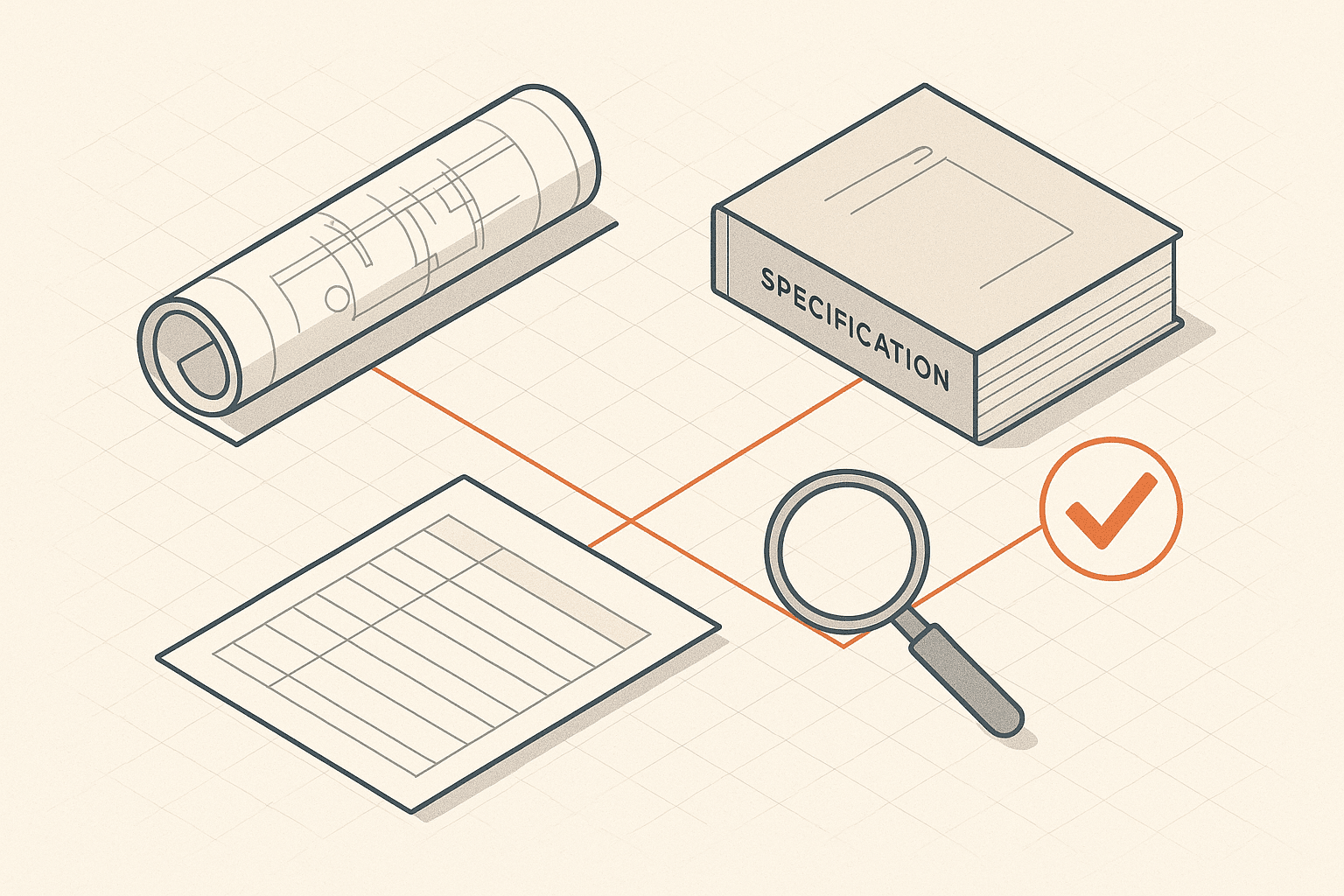
An isometric chat bubble hovering over a sprawling construction document set, some pages glowing green where the chat connects cleanly, others fading to grey beyond its reach, with a broken citation thread dangling.
Saves to public/blog/chatgpt-for-construction-documents/hero.png · run npm run generate-images
Plenty of project engineers already paste clauses into ChatGPT under the desk, and honestly, for some jobs it is the right move. The interesting question is not "is ChatGPT allowed" but "where exactly does it stop being trustworthy on a construction document set". I build document AI for a living, so here is the engineering answer, including the parts that are inconvenient for a vendor to admit.
What does ChatGPT genuinely do well on construction documents?
Used on one document at a time, ChatGPT is genuinely good. It explains a dense indemnity clause in plain language, summarises a 40-page scope of works, drafts a first-pass RFI or email, and answers "what does this term mean" faster and more patiently than anyone on site. For that class of work, it is excellent value for what you are already paying.
It is also a good thinking partner before a meeting with your lawyer or your client: paste a clause, ask what questions a careful contractor would raise, and walk in better prepared. None of that requires citations or a full project corpus, so none of it hits the failure modes below.
Where does ChatGPT fail on real construction document sets?
Four places, and they are structural, not bugs that next month's model will fix.
No verifiable citations. ChatGPT tells you what a document says but not where, and you cannot click through to check. When an answer will drive a decision, "trust me" is not a source. Worse, the failure is silent: the wrong answers read exactly like the right ones.
Hallucinated references. Ask for the clause that governs liquidated damages and you may get a confident answer citing clause 34.7 when your contract stops at clause 30. Models generate plausible text, and plausible clause numbers are what they produce when they miss the real one. On a one-off read you might catch it. Skimming twenty contracts, you will not.
Context limits on real sets. A chat window holds a contract, maybe two. A live project is thousands of documents: a drawing set of several hundred large-format sheets, specs, the email record, meeting minutes and every superseded revision. Even with uploads and Projects features, you are choosing a handful of files per conversation, which means the answer is only ever as good as your guess about which documents matter. The document you did not upload is usually the one with the conflict in it.
Confidentiality. On consumer ChatGPT plans, conversations may be used for model training unless you opt out; Team and Enterprise plans exclude business data from training by default. Separately, many construction contracts restrict disclosing the counterparty's documents to third-party services at all. Check both before your subcontract goes into any chat window, ours included.
Why do citations matter so much in construction?
Because in construction, the answer is usually an argument you will have to win later. A notice deadline, a variation entitlement, a spec compliance call: each one eventually gets contested, and what survives contest is not the AI's answer, it is the clause, the drawing note and the email you can put on the table. An uncited answer is unusable in exactly the moments you needed it.
Here is the part most vendors will not tell you: even purpose-built citations break in embarrassing ways unless you verify them. In our own pipeline we found that when the model wrapped its quoted evidence in stray formatting, our citation matcher silently fell back to the head of the source chunk, and a batch of answers ended up pointing at the wrong location, in one production case 18 citations collapsing onto 4 anchors. We only caught and fixed it because every citation is checked against the source document and flagged when the anchor cannot be trusted. A general chatbot has no such layer, and no way to tell you when its reference is decorative.
When is ChatGPT enough, and when do you need a purpose-built tool?
ChatGPT is enough when the task is single-document, low-stakes and human verified: explain, summarise, draft, brainstorm. You need a purpose-built tool when the task is cross-document or the answer carries consequences. The practical dividing line is a question shaped like "does X agree with Y", where X and Y live in different documents.
That is the job Alloovium was built for: it ingests the whole project record, contracts, drawings, specs, emails and meetings, answers with citations that open the exact clause or drawing location, verifies those citations rather than merely generating them, and monitors notice deadlines against the contract's actual time bars. It works alongside Procore, Autodesk Construction Cloud, SharePoint and Outlook, so nothing needs to move. Our post on what AI document review can actually do sets out the standard we think any tool, including ours, should be held to.
How should you test any AI on your documents?
Run one adversarial test before you trust anything, ChatGPT or a paid tool. Take a project set where you already know the answer, ideally one containing a conflict you found the hard way, and ask three questions: something the documents answer, something they contradict each other on, and something they do not answer at all. A trustworthy tool gets the first right with sources you can open, surfaces the contradiction with both sources, and says "not found" on the third. Most tools fail the third question, and the ones that fail it confidently are the dangerous ones.
What to do next
Keep ChatGPT for explaining and drafting, it is good at those. For the questions with consequences, try the same test on Alloovium: book a demo with a real project set and click every citation. If your immediate problem is a notice rather than an evaluation, the free notice and claim drafter and notice time bar calculator run in the browser with no signup.
Reference
Frequently asked questions
Written by
Builds the retrieval, extraction and verification engine behind Alloovium. Writes about how the system reads construction documents and catches what humans miss.
See it on your set
Run Alloovium across your own contracts, specs and drawings.
Upload a project and watch it read, cross-reference and cite across the whole document set, and flag what conflicts.
Book a demoDiscussion
Comments
More dispatches
Keep reading
What can AI actually check across construction documents in 2026?
The gap between a slick AI demo and a real project set is where teams get burned. Here is what the technology does well, where it fails, and what to demand before you trust it.
CieloJune 13, 2026 · 3 minAlloovium vs Document Crunch: what's the difference?
One is a contract review specialist now owned by Trimble. The other reads the whole project record. A fair head-to-head so you can pick the right tool for your actual job.
 ZanderJuly 14, 2026 · 4 min